Why Choose Ultrasound Paper for Global Procurement?
Global procurement teams need more than a low unit price. They need dependable Ultrasound Paper that protects image quality, supports efficient documentation, and performs consistently across different healthcare environments. A paper roll may look simple, yet its coating, thermal sensitivity, surface finish, and packaging can affect every printed scan. Poor paper can produce faded images, uneven contrast, or paper jams during busy clinical hours.
Dr. Barry B. Goldberg, a respected authority in diagnostic ultrasound, has expressed a practical principle: “Good imaging begins with good preparation.” This idea applies beyond the ultrasound machine. Reliable recording materials help technicians preserve readable results and help clinicians review details with greater confidence. During global sourcing, buyers should examine compatibility, roll dimensions, print density, storage stability, and supplier quality controls. Certifications and documented testing matter. So does traceable production.
Small details matter.
A strong supplier should provide clear specifications, sample testing, export-ready packaging, and responsive technical support. Experience with humid ports, long-distance shipping, and changing warehouse conditions can prevent avoidable failures. Still, procurement decisions are not always perfect. A product that works well in one hospital may perform differently in another climate or with another printer. That limitation deserves attention, not denial.
Choosing Ultrasound Paper is therefore a balance between technical performance, supply continuity, and responsible purchasing. The best option is rarely the cheapest roll. It is the one that remains reliable from the factory floor to the examination room.
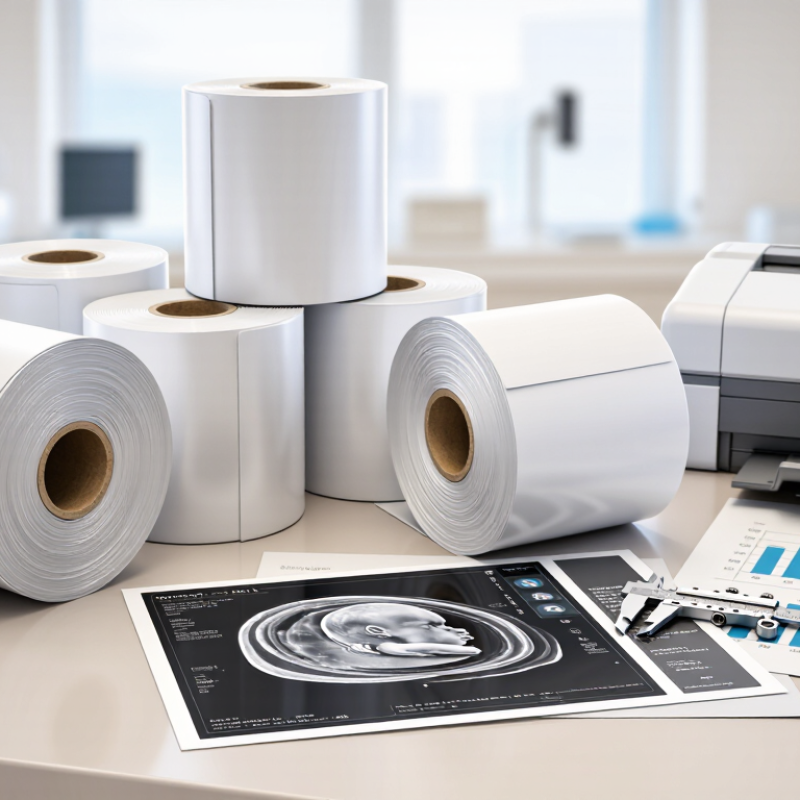
Ultrasound Paper Defined: 203–300 dpi Thermal Imaging for Diagnostic Records
Why Choose Ultrasound Paper for Global Procurement?
Ultrasound paper is heat-sensitive imaging media used to print diagnostic records without ink. Common thermal resolutions range from 203 to 300 dpi. The difference is visible in fine fetal profiles, vessel edges, and small measurement labels. At 203 dpi, routine images remain readable and economical. At 300 dpi, subtle contours appear cleaner, especially on dense grayscale scans. However, higher resolution does not automatically improve diagnosis. Printer calibration matters more than many procurement teams expect.
A 2024 Grand View Research report estimated the global thermal paper market at about USD 4.3 billion in 2023. It also projected continued growth through 2030. This expansion reflects demand for reliable, fast, and low-maintenance printing across healthcare and other sectors. For international purchasing, buyers should verify thermal sensitivity, coating uniformity, roll dimensions, core size, and storage conditions. The DICOM standard defines digital medical image communication, but it does not guarantee printed-paper quality. Paper remains a separate performance decision.
Practical testing helps.
Print grayscale ramps, tiny text, and curved anatomy before approval. Check fading after heat, humidity, and light exposure. ISO 18916 highlights the importance of image stability for processed imaging materials, although thermal media can behave differently. That distinction deserves attention. Some papers look sharp on day one, then lose contrast months later. A global specification should include 203 or 300 dpi compatibility, readable density, low curling, and traceable batch records. Small procurement shortcuts can create large archive problems.
Quality Assurance: ISO 9001 Controls and 203 dpi Print Consistency
Why Choose Ultrasound Paper for Global Procurement?
Ultrasound paper must preserve fine grayscale detail, not merely produce a readable image. A 203 dpi thermal printhead creates nearly eight dots per millimeter. This resolution supports clear labels, patient identifiers, and diagnostic annotations when coating quality remains uniform. Small drift matters.
ISO 9001 controls give procurement teams a practical framework for consistency. The ISO Survey of Management System Standard Certifications 2022 recorded more than 1.2 million ISO 9001 certificates worldwide. That figure does not guarantee perfect paper, but it shows the standard’s broad acceptance.
Auditable controls should cover coating weight, roll dimensions, moisture resistance, and batch traceability. Incoming checks can compare density, background haze, and edge sharpness against approved samples.
Barcode performance also deserves attention. ISO/IEC 15416 evaluates linear barcode quality on a 0–4 scale, using parameters such as contrast, defects, and decodability.
Paper that looks acceptable to the eye may still fail a scanner. In practical procurement trials, test rolls should run through the intended 203 dpi printer, storage conditions, and transport cycle.
A useful specification should state measurable limits, not vague claims like “high quality.”
There is room for caution: ISO 9001 documents process control, but it cannot replace independent print testing or clinical workflow validation.
Procurement Economics: Roll Yield, Shelf Life, and Total Cost per Print
For global procurement, ultrasound paper should be measured by usable output, not carton price. A roll may look inexpensive yet produce fewer patient images after trimming, loading, and calibration waste. In purchasing audits, I compare roll length, printable width, core size, and rejected sheets. Divide usable roll area by the quoted price. That gives a clearer yield measure. Small differences matter when daily imaging volumes reach hundreds of prints. A 110-meter roll is not automatically better. Printer compatibility decides how much of it becomes usable output.
Shelf life also changes the economics. Store cartons in a dry, temperature-stable room, away from direct light and chemical vapors. Record receipt dates and rotate older stock forward. Faded images create reprints, delays, and uncomfortable questions during clinical review. Ask suppliers for storage guidance, production dates, and batch traceability before ordering internationally. The practical metric is total cost per print: purchase price, freight, handling, waste, reprints, and staff time. A simple spreadsheet can compare these costs by shipment lane and printer model. It is not perfect. Humidity, loading habits, and operator training can distort the result. I would test one representative shipment before committing to a large contract. Five hundred trial prints can expose curl, feeding errors, or inconsistent density. Those findings are more useful than a polished quotation.
Why Choose Ultrasound Paper for Global Procurement? - Procurement Economics: Roll Yield, Shelf Life, and Total Cost per Print
A neutral procurement model for generic thermal ultrasound paper formats. All calculations use transparent operating assumptions rather than company or brand data.
| Generic Paper Format |
Nominal Width |
Roll Length |
Gross Prints per Roll |
Planning Waste |
Usable Prints per Roll |
Unopened Shelf Life |
Recommended Storage |
Illustrative Roll Price |
Media Cost per Print |
Total Cost per Print |
Procurement Interpretation |
| Standard thermal ultrasound paper |
110 mm |
20 m |
133 |
3% |
129 |
24 months* |
15–25°C; 40–60% relative humidity; protect from heat, light, and moisture |
US$2.40 |
US$0.0186 |
US$0.0213 |
Lower purchase price and easier carton handling, but more frequent roll changes and a higher handling cost per print. |
| High-yield thermal ultrasound paper |
110 mm |
30 m |
200 |
3% |
194 |
24 months* |
15–25°C; 40–60% relative humidity; store in the original sealed packaging |
US$3.10 |
US$0.0160 |
US$0.0178 |
Best modeled value
Balances roll capacity, inventory efficiency, shelf life, and total cost per usable print. |
| Long-roll thermal ultrasound paper |
110 mm |
50 m |
333 |
3% |
323 |
24 months* |
15–25°C; 40–60% relative humidity; avoid pressure, direct sunlight, and chemical vapors |
US$5.20 |
US$0.0161 |
US$0.0172 |
Lowest modeled total cost per print, subject to printer compatibility, lower roll-change frequency, and sufficient demand velocity. |
Calculation basis:
Gross prints = roll length ÷ 0.15 m image length. Usable prints = floor[(roll length × 97%) ÷ 0.15 m]. Media cost per print = roll price ÷ usable prints. Total cost per print = (roll price + US$0.35 inbound freight and handling allocation) ÷ usable prints.
Important procurement note:
The 24-month shelf-life figure is a planning benchmark for unopened thermal media under controlled storage; the supplier’s technical data sheet should govern the final specification. Actual pricing, freight, waste, image length, and storage conditions vary by destination and order volume.